It’s feasible to articulate the fundamentals of Innovation and its methods

The force of fundamentals
A framework of fundamentals for any subject or discipline is associated with a force for learning.
When education psychologist and cognitive learning theorist, Jerome Bruner, introduced the conceptualization called “structures of the discipline,” he argued that:
- “The curriculum of a subject should be determined by the most fundamental understanding of the underlying principles that give structure to the subject”
- The discipline’s structures represent “a minimum requirement for using knowledge, for bringing it to bear on problems and events one encounters.”
Drawing on the example of Algebra, Bruner proposed that students who learned about Algebra’s underlying principles, or structures, would be able to recognize all Algebra problems as “variations on a small set of themes.” This perspective, he argued, would support students in understanding and using Algebra.
Similarly, thought leader Peter Drucker described this type of explicating framework (“organizing principles”) as the basis for converting a skilled craft into a methodology or discipline by making it “broadly teachable,” as occurred in the past with the subject of Engineering, the method of “differential diagnosis” used by physicians, and the scientific method.
Indeed, long after Engineering had been converted into a discipline, many books for new Engineering students speak to the learning-leverage value of laying a foundation of a discipline’s fundamentals, such as this one: Principles of Engineering.
Innovation’s fundamentals
With Innovation and its methodology — pertinent to the vast majority of 21st century workforce roles — the prospect of a such a force for teaching and learning prompts the question: Is it feasible?
- Themes that connect the wide-ranging work of innovation practitioners and other experts, spanning decades and even centuries, indicate that it is feasible to establish Innovation’s “structures of the discipline” — the most fundamental understanding of the underlying principles that give structure to the subject of Innovation and its methods. In fact, the volume of work in recent decades has made fundamentals more visible.
- To demonstrate feasibility, this website offers provisional structures, or “fundamentals,” which aim to capture the driving constants that span Innovation’s widely varied expression.
-
 Feasibility matters because of the opportunity for significant learning leverage — especially among K-12 students. Plus, the content of this site’s provisional version of Innovation’s fundamentals highlights unexpected opportunities, including potential for:
- beginning instruction with Innovation’s methods early, including regular bounded hands-on practice
- the ready access ramp of hypotheses as a featured structure of Innovation’s methodology
- embedded cultivation of students’ personal interests and personal strengths
- trajectories of student development across grades.
- Overall, feasibility presents seeming opportunity to cultivate a needed population of engaged and purposeful Innovation agents — of difference makers.
What’s more, the opportunity seems to be available for the taking.
Terminology
Even the term, “Innovation,” is provisional at this website:
- Its use here might be considered a stand-in for the combination of “innovation and entrepreneurship,” following from an initial synthesis of sources. For example, one source identified innovation as the knowledge base of entrepreneurship, but also argued that the term, “entrepreneurship,” is widely misunderstood. Plus, multiple sources associated both labels with the same essential function.
- Alternate terms, especially for innovation’s methods, might be “difference making” or “change making.”
At this page: See provisional fundamentals for Innovation
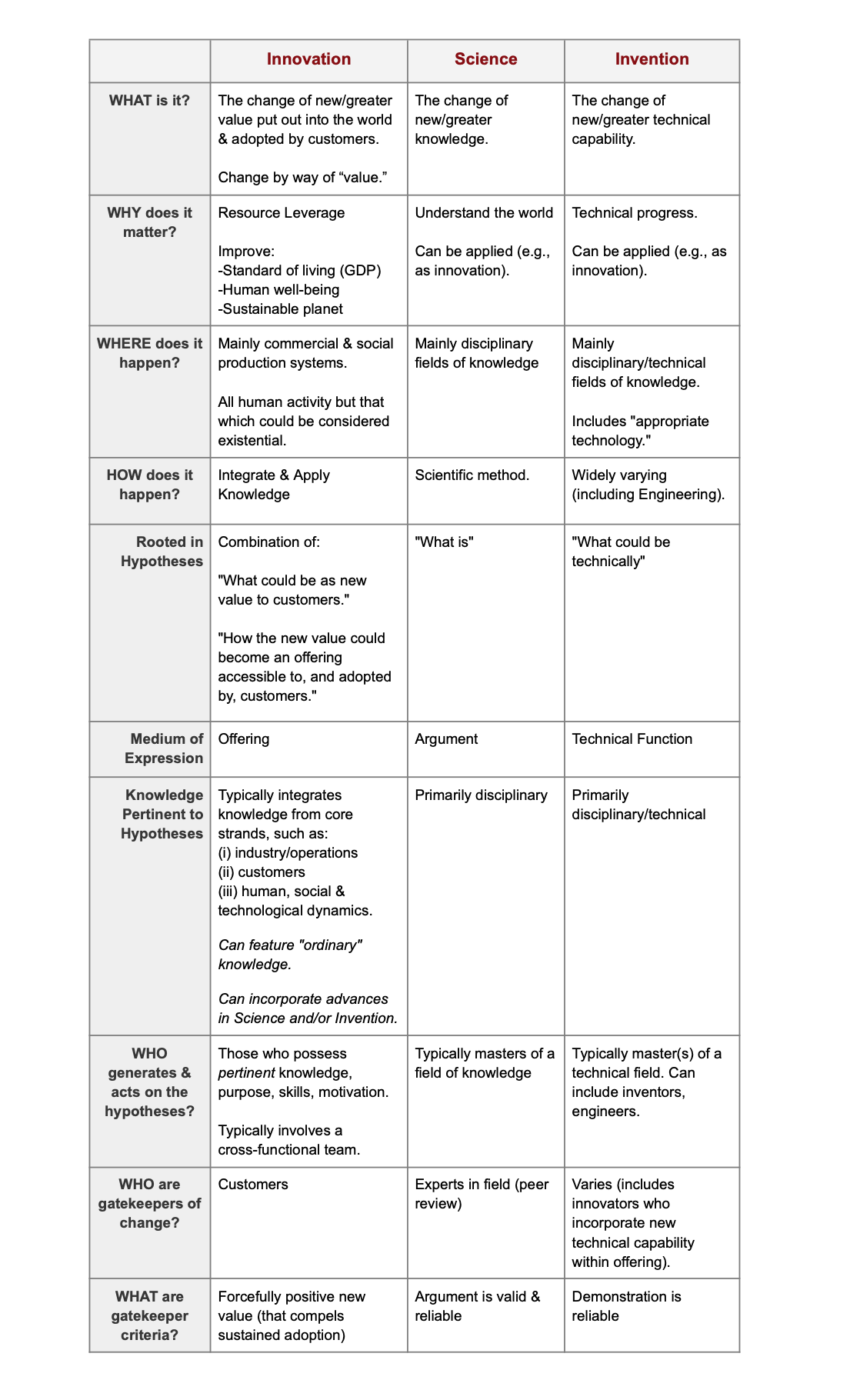
- Wide-angle view: In the table below, provisional fundamentals for Innovation are presented in relation to the equivalent for Science/Research and Invention. This wide angle view begins with the type of change that each practice, or methodology, produces.
- Zooming in on Innovation: Beneath the comparative table, see:
- Brief unpacking of the table’s entries for Innovation
- Link to document that provides a narrative synthesis of findings from initial sources, which led to the table’s entries.
- Link to Bibliography, which lists sources related to, both, the provisional framework of fundamentals and the associated opportunity for learning leverage.
WIDE-ANGLE VIEW –> Innovation’s Fundamentals in Relation to Science & Invention
Bruner also described that knowing a discipline’s structures “permits many other things to be related to it meaningfully.”
When it comes to Innovation and its methods, there is perhaps nothing more meaningful than understanding how it relates to Science and to Invention.
Indeed, this perspective became fundamental to this website’s provisional set of Innovation’s fundamentals:
- All three methodologies create change in the world.
Although each methodology creates a different type of change, the changes are sometimes closely related. In particular, certain examples of Innovation apply an advance, or change, from Science or Invention. -
 All three methodologies engage the same essential creative structure of hypotheses, or new connections of existing knowledge.
The imagination involved in making these new connections is described as “the ability to see possible new connections before one is able to prove them in any way.”
An idea may seem as if it comes from “thin air,” but in fact it comes from a purposeful new connection of existing knowledge.
Each methodology’s hypotheses correspond to its distinctive type of change. It’s the type of change, or purpose, that determines:
- the types of existing knowledge that are most pertinent to each methodology’s hypotheses
- who comes up with the hypotheses
- how hypotheses lead to each methodology’s distinctive type of change
- and so on.
In the table just below, see provisional fundamentals for Innovation in relation to Science/Research and Invention, beginning with the type of change that each methodology produces:
ZOOMING IN — Beginning to Unpack Innovation’s Fundamentals
Entries in the “Innovation” column of the above table are unpacked in brief just below.
WHAT is Innovation?
“Change by way of value”
In other words, value is innovation’s fundamental catalyst for change:
- “Where value is determined by customers.”
- Practitioners may seek to influence customers. But it is customers who decide whether or not to adopt an offering put out into the world (e.g., typically a product or service). Thus, it is customers who serve as the gatekeepers of innovation’s change. The essential practitioner stance can be described as “inner-driven and other-focused.”
- Consider the history of the electric car: First built by an English inventor in the 1880s, the early business potential of electric vehicles in the U.S. was eclipsed by customer interest in the Model-T. It took another 100 years for U.S. customer interest in the value of electric vehicles to take hold. By 2014, a range of eletric vehicle models were available for sale throughout the U.S., following development of a national battery charging infrastructure, reduced cost of batteries for the vehicles, vehicle design, and more.
- As put by business thought leader, Peter Drucker: “The test of an innovation is always what it does for the user.”
WHY does Innovation Matter?
 Even as the test of an innovation is what it does for the user, innovation’s fundamental function of resource leverage — generating more value from the same resources — occurs at the societal level and indirectly.
Resource leverage is the reason that Innovation matters so much:
- In the early 19th century, Jean Baptiste Say described the resource leverage function as the “production of wealth,” including the example of silk fabric as providing new and greater value from the resource of raw silk along with all other resources that went into producing the new fabric (e.g., labor, machinery).
- In the 21st century, resource leverage can be linked fundamentally to advances in three “P’s”:
- “Profit” — or “wealth,” represented by economic measures (e.g., GDP, Productivity) and associated with a nation’s standard of living
- “People” — represented by measures of a population’s well-being, or flourishing
- “Planet” — represented by measures of sustaining natural resources
- Indeed, in the early 21st century, panelists for a discussion held at the University of Michigan, entitled, ”Is Consumerism Sustainable?” agreed that “innovation” is the answer … “either gradually or by crisis.” It is up to innovation to advance yield on limited natural resources to at least maintain the standard of living among developed populations while also improving the standard of living among developing populations. This combination of ends could be viewed as opposing imperatives, and Jeffrey Sachs has added that “political will” will need to complement innovation.
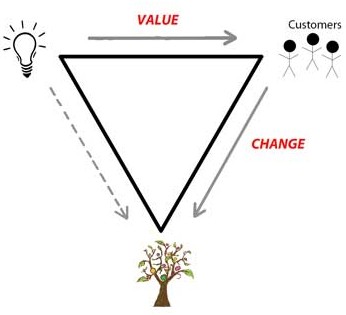
The following image depicts the role of customers as the gatekeepers of innovation’s broader function of resource leverage:
- Innovation practitioners offer new value to customers.
- Customers respond to the offering, either by adopting it, or not
- It’s only if customers adopt the proposed new value that resource leverage can result.
WHERE does Innovation Happen?
At large scale, Innovation happens in the overall economy — typically in what is known as the “commercial production system” (for-profit businesses of all types and sizes) or in the “social production system” (non-profit and/or government organizations, including schools, hospitals, and much more).
In the words of Peter Drucker:
“… (I)nnovation is an effect in economy and society, a change in the behavior of customers, of teachers, of farmers, of eye surgeons – of people in general. Or it is a change in how people work and produce something.”
- Drucker called offerings enabled by new technology as only the “cutting edge of the knife” — far from the whole knife. In other words, offerings of new value do not require association with new technology.
- In fact, Drucker described that innovation’s practice pertains to “all activities of human beings other than those one might term ‘existential’ rather than ‘social.’” Change-by-way-of-value can be catalyzed almost anywhere, including in K-12 classrooms, neighborhoods, extracurricular organizations, etc.
Finally, Stephen Goldsmith noted two distinctions regarding innovation in the “social production system” — distinctions that might be thought of as a “social differential”:
- First, the change to be catalyzed by “new value” often is change in human behavior or capability. With this, “adoption” extends beyond purchasing, or accepting, the offering. For example, catalyzing change can require use of the offering and even effective use (e.g., Narcan to reverse a drug overdose). Plus, in certain fields (e.g., Education) there may be multiple levels of users (e.g., teachers and students), with effective use of an offering needed at each level to realize the effect of resource leverage.
- Second, the humans doing the changing are not necessarily the purchasers of the offering (e.g., a city council may provide funds for new public transit, intended to provide value to prospective riders). In these cases, “value” must catalyze adoption among both purchasers and users.
HOW does Innovation Happen?
Ideas plus Action.
Innovation thought leader, Clayton Christensen, described innovation as distinctively “integrating and applying” knowledge.
Innovation’s methods — for both ideas and action — are rooted in its core creative structure of hypotheses (purposeful new connections of existing knowledge). Again, the imagination underlying hypotheses is described as “the ability to see possible … connections before one is able prove them in any way.”
Whether the hypotheses are tacit or explicit and stable or changing, Innovation’s methods always feature two complementary types of hypotheses. Both types are needed:
- “What could be” as new value to customers — value compelling enough to catalyze sustained adoption.
- “How the new value could become” an offering accessible to, and adopted by, customers — hypotheses that determine a roadmap for effective action.
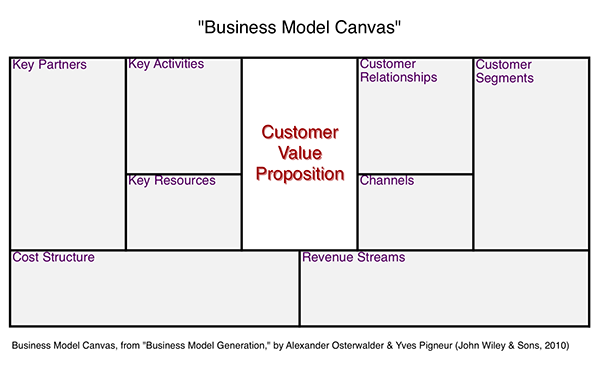
This combination of hypotheses can be viewed as fitting within the context of the “business model canvas,” depicted just below, where the main cell of “core value proposition” represents “what could be,” and all of the other canvas cells represent hypotheses for “how it could become.”
Innovation’s “what” and “how” hypotheses typically integrate knowledge from core strands, such as:
- industry/domain knowledge
- customer knowledge
- human, social & technological knowledge
- anything and everything.
In 2026, artificial intelligence (AI) might also be listed as a core strand of knowledge in order to bring it forward as it is newly emerging. Eventually, AI might represent a standard technology and fit under “human, social & technological knowledge.”
With respect to the knowledge strand of “anything and everything,” Steve Jobs provided an example in referring to his undergraduate experience with calligraphy as integral to his development of fonts for Apple computer systems:
- “Reed College at that time offered perhaps the best calligraphy instruction in the country. Throughout the campus, every poster, every label on every drawer was beautifully hand calligraphed. Because I had dropped out and didn’t have to take the normal classes, I decided to take a calligraphy class to learn how to do this. I learned about serif and sanserif typefaces, about varying the amount of space between different letter combinations, about what makes great typography great.”
- “None of this had even a hope of any practical application in my life. But 10 years later, when we were designing the first Macintosh computer, it all came back to me and we designed it all into the Mac. It was the first computer with beautiful typography. If I had never dropped in on that single course in college, the Mac would have never had multiple typefaces or proportionally spaced fonts. Since Windows just copied the Mac, it’s likely that no personal computer would have them.”
- “If you’re gonna make connections which are innovative… you have to not have the same bag of experiences as everyone else does.”

WHO Generates & Acts on Innovation’s Hypotheses?
Those who possess pertinent knowledge, skills, purpose, and motivation.
The work of generating and acting on a new offering’s collection of “what” and “how” hypotheses is typically collaborative and often cross-functional — including collaborative participation by individuals with varying perspective or knowledge. Cross-functional collaboration often features specialized knowledge and skills (e.g., communications, design, finance, science, engineering). In any situation, collaboration is likely to involve individual talents, strengths and interests.
For example, when Google’s two computer-scientist founders had identified an approach to Internet search that they viewed as offering more value to customers than what was then widely available, it was a non-scientist colleague who contributed the key “how” hypothesis for generating revenue from the offering, which was based on a proposed new type of value to advertisers.
As with the Google source-of-revenue example, it’s likely that offering new value suffuses innovation’s array of “how” hypotheses and its overall practice — not just the “what could be” hypothesis. As another example, consider the “Partners” cell of the Business Model Canvas: If prospective partners are to accept (“adopt”) a partnership proposal for supporting a “what could be” idea for new value, they must find in that proposal compelling new value that catalyzes their acceptance.
The Ocean Cleanup offering illustrates a particular “how” hypothesis that offered scientists and other skilled professionals the value of participating as a volunteer in developing a whole new way to remove plastic from oceans: In 2012, when the Ocean Cleanup’s young founder, Boyan Slat, needed unpaid support from technical experts to serve as resources to help him develop the new technical capability that would enable his novel “what could be” concept for removing plastic from oceans, he delivered a TED Talk.
- The talk drew early voluntary participation from technical experts around the world, with the unpaid nature of these integral contributions speaking to the value that professionals found in participating.
- In this situation, one could say that the technical experts were customers of a compelling offering of engagement — in particular, engagement of their personal knowledge and strengths — and of meaning — connection to a purpose both larger than themselves and personally compelling.
- To fast forward over ten years, in November 2025, the Ocean Cleanup announced over social media: “This year, we’ve been collecting an average of 53 kilos of trash (from oceans) every minute.”
The people who generate and act on innovation’s hypotheses are located anywhere and everywhere, including in organizations of all types and sizes. Again, Peter Drucker held that this practice pertains to “all activities of human beings other than those one might term ‘existential’ rather than ‘social.'”
Finally, even if “what” and “how” hypotheses — whether implicit or explicit and whether stable or changing — are fundamental and constant across Innovation’s widely-varied examples, there is not a standard practitioner pathway to these hypotheses. A few examples of pathways include:
- observing an unmet need among customers or a segment of consumers (e.g., stress-free ways to commute by bicycle)
- observing an opportunity to apply technical capability (e.g., applying GPS to public transportation so riders could know where a bus/train is located on a route)
- detecting pure new opportunity, which might include hypothesizing that customers don’t realize they have a particular “unmet need” (e.g. silk fabric, smart phones)
- addressing a suboptimal equilibrium in the marketplace (e.g, low usage rate of Skype for video calls, including international calls, even though it was free, which Zoom overtook upon the COVID pandemic)
- addressing a known problem in the marketplace (e.g., the high cost and low supply of housing in the U.S.) and/or in a production system.
See more detail and sources:
- Narrative-form document discussing initial sources of these provisional fundamentals of Innovation.
- Bibliography listing comprehensive sources related to the fundamentals, plus sources for the learning-leverage opportunity.
Other key elements of this website:
- Nature of Learning Leverage: See a description of the K-12 learning-leverage opportunity associated with an established framework of Innovation’s fundamentals.
- Sketch of Potential Supplemental Tool: See a conceptual sketch of a searchable online gallery of wide-ranging innovation examples, illustrating one way to provide an intentional collection of concrete Innovation examples. This type of tool is intended to complement — to help bring to life — the core and driving Innovation fundamentals that underlie every widely-varying example. Examples also are to inspire students.
- Prototype of the Potential Supplemental Tool: See a prototype version of the searchable online gallery of Innovation examples. The prototype, which doesn’t include all that is depicted by the sketch, is to help imagine what such a supplemental tool might be like.