
“It was the skill and passion of 100 volunteers that brought us from idea to feasible concept in a year.”
| Offering |
A way to remove trillions of pieces of plastic polluting Earth’s oceans, in 5 years rather than 79,000 years. |
| Value Proposed | A compelling possibility for realizing a marine environment that is safer, cleaner, and more fruitful. |
| Resources that Offering Makes More Of | i. Ocean currents — natural movement concentrates location of plastic pollution. ii. Teen founder’s strengths, purpose, and knowledge. iii. Knowledge and attention of hundreds of world-class experts (initially volunteered engagement). |
| Societal Progress | “Planet” Reduce marine deaths & threats to ecosystem (including survival of ~100 threatened species). Recycle the plastic (e.g., into oil). “People” Increase human health by reducing toxic chemicals entering food chain (threats include cancer & fetus malformation).” “Profit” i. By selling the recyclable plastic, the cleanup more than pays for itself. ii. Avoid billions of dollars of new damage to industries (e.g., fishing, shipping, tourism, cleaning coastlines). Annual $13 billion damage to industries in U.S. alone. |
1. Agent’s Path to Offering
Puzzle Solving with Purpose
- In 2009, when the Ocean Cleanup’s Dutch founder, Boyan Slat, was age 16: “I first became aware of the plastic pollution problem when diving in Greece, coming across more plastic bags than fish. Unfortunately, the plastic does not go away by itself. Hence I wondered; Why can’t we clean this up?”
- Slat learned that experts considered the problem too vast for clean up — saying it would take “79,000 years to remediate” the problem.
- But “Slat had always enjoyed working out solutions to puzzles, and while pondering this one, it came to him – rather than chase plastic, why not harness the currents and wait for it to come to you?”
- The potential leverage for catalyizng change in this vast pollution might come from the value of a whole new type of technical capability.
- Back at school, in the Netherlands, Slat developed his technical idea further, working with a student partner, as part of a science project.
- Slat and his high school partner put this invention hypothesis to its first significant test by creating prototype barriers and returning to the Mediterranean to conduct a series of tests
- The results fueled his belief. The potential for applying this invention provided the context for Slat’s approach to college, where he continued to pursue knowledge that pertained to the purpose of ocean cleanup.
2. Hypothesis: “What Could Be as New Value”
“Why not use the enemy to our advantage?”
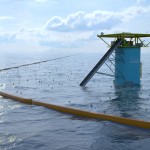 An array of floating barriers, anchored to the sea bed, would first catch and concentrate the floating debris.
- The plastic would move along the barriers toward a platform, where it could then be efficiently extracted.
- The ocean current would pass underneath the barriers, taking all buoyant sea life with it.
- There would be no emissions, and no nets for marine life to get entangled in.
- The collected ocean plastic would be recycled and made into products – or oil.
- Note that this “what could be” hypothesis was, on the one hand, about possible new technical capability — essentially, an invention hypothesis. However, Slat’s focal purpose was change by way of value. He believed this technical capability, if demonstrated, would be widely adopted by “customers” as the means to catalyzing change.

3. “How” Hypotheses
Channel of Distribution — Initially for the Idea
Despite continued positive reinforcement from personal experimentation, including encouraging results with the early prototype barriers, Slat described basically getting nowhere fast with putting the idea into action until a 2012 Netherlands TED Talk that he gave went viral.
- The talk served as the “channel of distribution” for getting his idea to initial segments of “customers” — those who would actively participate in the initial “how” of his effort: a technical feasibility study.
- One key customer segment was experts from around the world who found such compelling value in the idea such that they volunteered their expert knowledge and time.
- Another key customer segment was a “crowd” of similar believers who would provide financial support for the study via crowdfunding.
Developing the Offering — One Key Task at a Time
As of 2013, Slat employed a basic business model’s set of “how” hypotheses for each of a series of tasks, beginning with founding The Ocean Cleanup and conducting a Feasibility Study.
- Each task, highlighted just below, featured: particular customers, channels for reaching customers, key activities, resources, costs, and revenue sources.
- Tasks often included partners too.
- Detail about each task is at its website.
1. Feasibility Study
Slat and his team of ~100 mainly volunteer experts went “somewhere” fast with the Feasibility Study.
They set out to disprove the status quo “expert” assumption that a cleanup of the infamous ‘Great Pacific Garbage Patch’ is impossible.
“It had always been assumed that cleaning the oceans was impossible, due to the vastness of the areas in which plastic is concentrated. Using vessels and nets to collect the plastic from one garbage patch would take about 79,000 years and tens of billions of dollars. Besides, such an operation would cause significant harm to sea life and generate huge amounts of CO2 and other emissions.”
In just over a year, Ocean Cleanup produced the following press release about feasibility results:
“June 3, 2014, New York – The Ocean Cleanup, founded by Dutchman Boyan Slat, has unveiled its feasibility report today, concluding that its concept is a viable method to clean the oceans from plastic. The report is the result of more than a year of extensive scientific research in engineering, oceanography, ecology, maritime law, finance and recycling. The feasibility study was financially supported by (the combination of) crowd funding and professional in-kind contributions. The research was done by an international team of over 100 experts, predominantly on a voluntary basis. The next step, building and testing large-scale operational pilots, will be initiated as soon as sufficient funding has been raised.”
A new video was released too:
2. Model Testing
“How” hypotheses for the next large task completed was described at the organization’s web site:
- In order to bridge the gap between the outcome of the feasibility study and full implementation of the concept, the execution of a series of up-scaling tests ultimately resulting in a large-scale operational pilot is needed.
- To minimize costs, The Ocean Cleanup will act as a facilitator for the research, outsourcing most of the fundamental research to institutes and collaborating with offshore and engineering companies to cover most of the costs.
- (At least fourteen research partners signed on for an ocean expedition element of the testing alone.)
- Based on this approach, The Ocean Cleanup then sought 2 million dollars via crowd funding for the execution of its next phase.
3. Coastal Pilot

As positive results of the above Model Testing task put The Ocean Cleanup one large step closer within its “how it could become” model, focus shifted to the “how” of a Coastal Pilot:
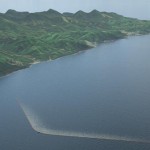
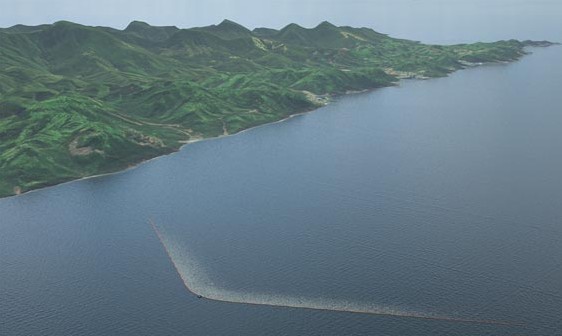
- On May 20, 2015, The Ocean Cleanup and the city government of Tsushima (a Japanese island which lies between Japan and Korea) jointly agreed to conduct research to bring the world’s first ocean cleanup array to Tsushima Island.
- Deployment expected in Q2 2016 was realized on time. See this June 2016 news report.
- Even though the pilot coastal array, spanning 2000 meters with a barrier length of over 2300m, would represent just 2% of the full scale structure envisioned, it would become the longest floating structure ever deployed on the oceans. Most important, it would be the first time an operational Ocean Cleanup system would be deployed in the ocean.
 As of 2015, the organization continued to invite volunteer engagement. However, its full-time resources had grown considerably: “At The Ocean Cleanup we work with a team of over 100 committed people, performing research in the fields of engineering, physical oceanography, ecology, finance, maritime law, processing and recycling.”
4. Offshore Pilot
- As of 2015, this was an upcoming Task
- We know the results were successful, since The Ocean Cleanup has been fully scaled up.
5. Full-scale Cleanup
- Again, as of 2015, this was an upcoming task
- Stated in that year: “The Ocean Cleanup’s goal is to fuel the world’s fight against oceanic plastic pollution by initiating the largest cleanup in history.”
- These days, you can follow the enterprise’s regular updates on social media.
4. Value to The Ocean Cleanup’s Agents and to its Customers
Again, successful results make the answer seem easy. But again, the path to success was not easy. The work was fueled by the value of a compelling purpose and equally compelling picture of possibility as viewed by Slat, by hundreds of technical experts (initially involved as volunteers), by all those who contributed to crowdfunding and to other funding, and by early partners in the series of “how” tasks.
The “what could be” hypothesis itself was grounded in value, which drew pertinent knowledge, expertise, funding, and partners.
During The Ocean Cleanup’s initial stretch of scaling up, Boyan Slat received widespread recognition: One of the 20 Most Promising Young Entrepreneurs Worldwide (Intel EYE50). Crowned 2014 Champion of the Earth, the United Nations’ highest environmental accolade. In 2015, HM King Harald of Norway awarded Slat the maritime industry’s Young Entrepreneur Award. And The Ocean Cleanup was the 2015 winner of Fast Company’s “Innovation by Design” award in the social good category.
Follow its ongoing journey of ocean cleanup on social media.
Sample Sources: